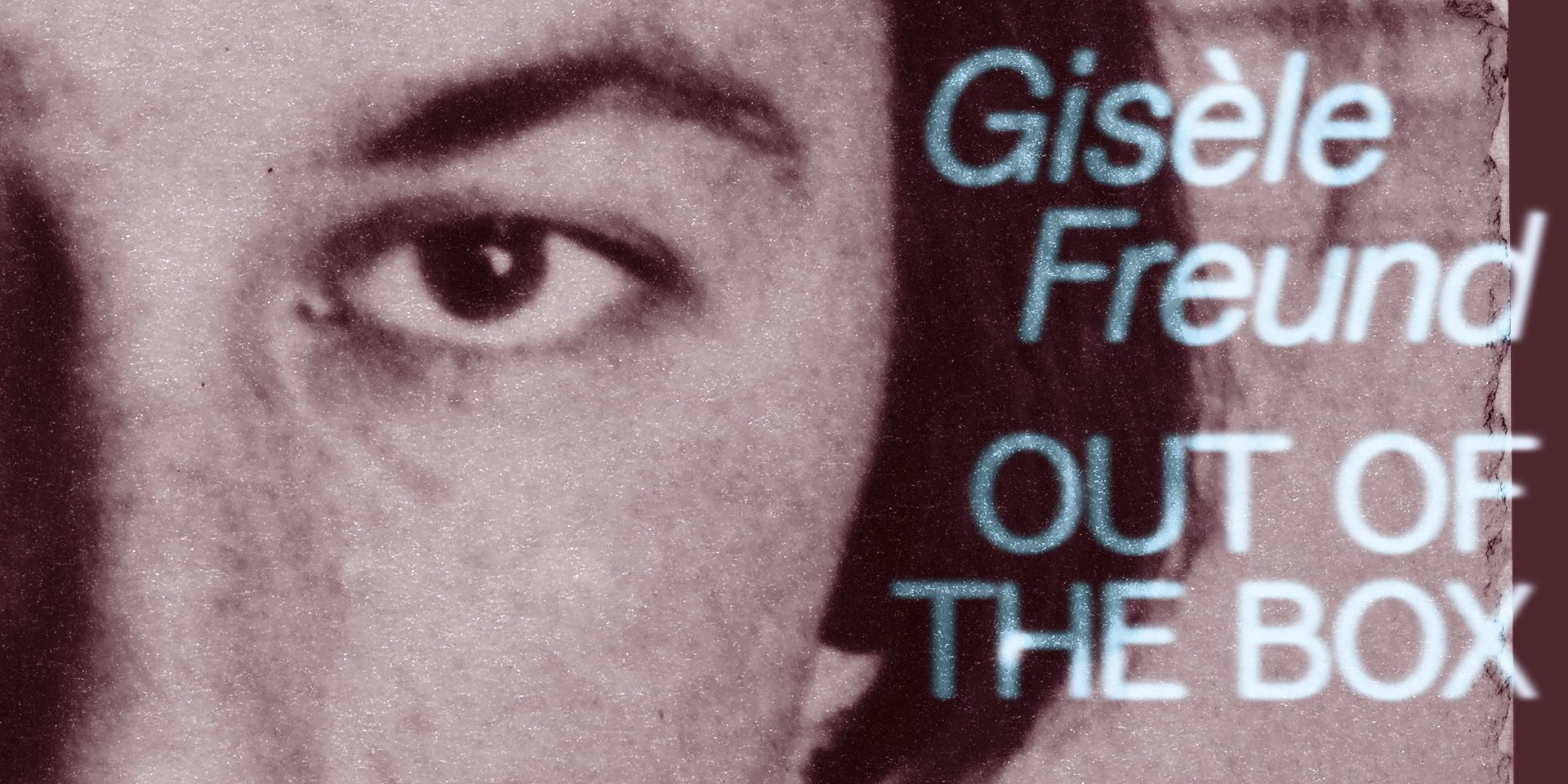
Photographer and sociologist, pioneer of the 35mm camera, member of the radical “Red Student Group,” German-Jewish émigré, and journalist—Gisèle Freund was many things at once, and she was always driven.
Freund earned international acclaim for her color portraits of figures like Walter Benjamin, James Joyce, Simone de Beauvoir, and Frida Kahlo, as well as many other contemporary intellectuals, writers, and artists. This major solo exhibition at the Jewish Museum Frankfurt focuses on facets of her work that have received little attention to date, for instance her sociological perspective on the world, her photographic experiments, and the international network of women, including Adrienne Monnier and Victoria Ocampo, that enabled her to survive the years in exile.
“OUT OF THE BOX: Gisèle Freund” offers a view into the extensive collection the Jewish Museum Frankfurt acquired from the estate of Hans Puttnies and other sources. For the first time, previously unpublished vintage photographs by Gisèle Freund are displayed alongside her personal notes and manuscripts. The material, which was stored away in 32 archival boxes and inaccessible to the public for years, is presented alongside Freund’s well-known portraits, photo journalism, and books, as well as photographic experiments that were for the most part unknown. The works, documents, and sketches on display bear witness to Freund’s profound independence, her talent for friendship, and her keen, uncompromising insight into social injustice, hardship, and discrimination—as well as her passion for writing and her experience of twofold exile.
Gisèle Freund

With her photographs of numerous figures from the worlds of literature, art, and politics, Gisèle Freund left her mark on twentieth-century photography.
Born Sophia Gisela Freund in Berlin on December 19, 1908, she came into contact with the visual arts at a young age. Her father, the textile manufacturer Julius Freund, collected art and gave his daughter her first 35mm camera; she used it to experiment, capturing, in particular, scenes she observed on the street. As a member of the “Red Student Group,” she documented protests and demonstrations in Frankfurt am Main, where she studied sociology with Karl Mannheim and Max Horkheimer. Norbert Elias, assistant to Horkheimer, suggested that she write her dissertation on the new medium of photography. During this time, she also began producing her first photo-reportages. After the Nazis seized power, Freund, a Jewish socialist, was forced to flee. Upon arriving in Paris, she changed her identity and Gisela became Gisèle Freund.
Freund amassed a network of writers and intellectuals and, together with Richard (“Rix”) Rosenthal, a friend from Frankfurt, set up a photo agency called “Girix.” When German authorities refused to renew her passport in 1936, she decided to wed a French citizen to avoid the threat of statelessness, marrying a friend of her then-partner, Adrienne Monnier. When the Germans occupied France, Freund was forced to flee once again, eventually reaching Argentina in 1941 with the support of Victoria Ocampo. Once there, she traveled widely, for instance to Patagonia with Elisabeth Prévost. She worked for the Ministry of Information of the exiled French government and became a member of the renowned Magnum photo agency. She photographed for TIME, Life, and other prominent media outlets, and later moved again, this time to Mexico, where she spent a great deal of time with Frida Kahlo. In 1952, she returned to Paris and remained there for the rest of her life. Following her death on March 31, 2000, she was laid to rest in Montparnasse Cemetery.
The Gisèle Freund Collection at the Jewish Museum Frankfurt
In December 2022, with the support of the City of Frankfurt, the Jewish Museum Frankfurt acquired an extensive collection of photographs and documents by Gisèle Freund from the estate of the author, director, and media scholar Hans Georg Puttnies.
The collection comprises more than 1,150 photographs dating from 1927 to 1975, approximately half of which are vintage prints. It also includes previously unpublished manuscripts, such as the typescript of an unfinished autobiographical novel Freund wrote in Mexico between 1952 and 1954, as well as personal notes, address books, letters, and other documents. Following further acquisitions, including material from the estate of gallerist Maria Ruiter, the museum now holds the largest collection of photographs and documents by Gisèle Freund in Germany.
Exhibition Themes
The exhibition is organized into four rooms, each of which is dedicated to a theme and begins with works from the years 1929–33, when Gisèle Freund was studying sociology in Frankfurt with the aim of becoming a journalist. During this time, she developed the critical view of society that would go on to shape her later work as a photographer, sociologist, and photojournalist.
Photographic Aesthetics: Color, Social Analysis, and Experimentation
Freund’s interest in the potential of the 35mm camera was boundless. Open to a wide aesthetic spectrum ranging from art-historical influences to the latest trends in advertising and the illustrated press, she explored various ways to transform the photographic image. Her use of the new color films manufactured by Kodak and Agfa for portraiture was pioneering. Her photographs of intellectuals and writers in Paris and London in the years 1938 to 1940 earned her a reputation as a “portraitist of the mind”—and soon global fame. One of her earliest color images, a portrait of James Joyce, appeared on the cover of TIME magazine in 1939.
Despite her experiments with the possibilities color photography offered, Gisèle Freund continued to work extensively in black and white for many years. Because these images were easily reproduced in books and magazines, it was her photojournalistic work that achieved the widest circulation. Her first published photo essay focused on a puppet theater in Paris; this was followed by others, including a series documenting the living conditions of workers in the north of England during the Depression. Additional series addressed socio-critical themes such as poverty, prostitution, public demonstrations, and political violence.
Writing, Thinking, Photographing
In her dissertation on nineteenth-century bourgeois society and the origins of photography, Gisèle Freund produced one of the first sociological studies on the relationship between the new medium and wider social change. Throughout her life, she would return to this theme again and again; to this day, her monograph Fotografie und Gesellschaft (Photography and Society) remains a frequently cited work in academic research. Freund also wrote about photography, whether in the form of texts accompanying her reportage or as essays and books dedicated to the medium. Her writing is characterized by a critical and analytical perspective on society, an approach she cultivated during her studies at the Institute for Social Research in Frankfurt.
Friendships and Networks
Whether rooted in friendship, intellectual exchange, professional collaboration, or, at times, romance—some of her relationships were significant for a brief period only, while others lasted a lifetime. The networks that Gisèle Freund built, particularly with other women, were essential both to her survival during her years in exile and to her professional career within a male-dominated field.
This exhibition is the first to examine the photographer’s life and work through the lens of gender. It focuses on six women who played various roles in her life, either as partners, mentors, friends, or lovers: Victoria Ocampo, Adrienne Monnier, Elisabeth Prévost, Frida Kahlo, Verna B. Carleton, and Simone de Beauvoir.
Accompanying Program
The accompanying program traces the path of Gisèle Freund, exploring the women, friendships, and networks that shaped her journey, as well as her own influence on young women photographers. Through discussions, films, guided tours, and creative formats, the program offers new perspectives on the Jewish experience, exile, and starting from scratch—while demonstrating how Freund’s unique vision continues to resonate to this day.
A catalogue in German and English language accompanies the exhibition; it features a wealth of photographs, essays by Griselda Pollock, Dorothee Linnemann, and Anna Sophia Messner, a foreword by Mirjam Wenzel, and an introduction by curators Lorraine Audric and Friedrich Tietjen.
“OUT OF THE BOX” is realized in collaboration with the Institut Mémoires de l’édition contemporaine (IMEC) and is presented as part of the Bicentenaire de la Photographie (Bicentennial of Photography) initiative of the French Ministère de la Culture (Ministry of Culture).
The LVR Landesmuseum Bonn is presenting “Fluchtpunkt Paris. Gisèle Freund, Rogi André, Madame dʼOraa” (Vanishing Point Paris: Gisèle Freund, Rogi André, Madame d’Ora) through February 7, 2027.
Through February 10, 2027, the Leica Galerie Frankfurt is hosting the exhibition "Echoes of the Past. Gisèle Freund im Spiegel heutiger Fotografie" (Echoes of the Past: Gisèle Freund in the Mirror of Contemporary Photography), featuring works by Gisèle Freund, Jessica Backhaus, and Andrea Hoyer.
The development of the collection was made possible with the kind support of the City of Frankfurt and the Georg and Franziska Speyer Scholarship Foundation.



Event location:
Jewish Museum Frankfurt
We're closed today
- Museum ticket (permanent exhibition Jewish Museum+Judengasse) normal/reduced12€ / 6 €
- Kombiticket (temporary exhibition+ museum ticket) normal/reduced14€ / 7€
- Temporary Exhibition7€
- Family Card20€
- Frankfurt Pass/Kulturpass1€
- Kids under 18free
- Every last Saturday of the month ("Satourday")free
- Entrance to the building (Life Deli/museum shop/library)free
Reduced entry for:
Students / Trainees (from 18 years)
People with disabilities from 50 % (1 accompanying person free)
Volunteers (Voluntary Social Year, Voluntary Ecological Year, Federal Volunteer Service or International Youth Volunteer Service)
Unemployed people
Frankfurt Card holders
Free entry (only for exhibitions) for:
Members of the Society of our Friends and Patrons association
Birthday children of all ages
Children and teenagers up to 17 years
Students of the Goethe University / FH / HfMDK
Apprentices from Frankfurt
Refugees
Holders of Museumsufer-Card or Museumsufer-Ticket
Members of ICOM or Museumsbund
Bertha-Pappenheim-Platz 1, 60311 Frankfurt am Main