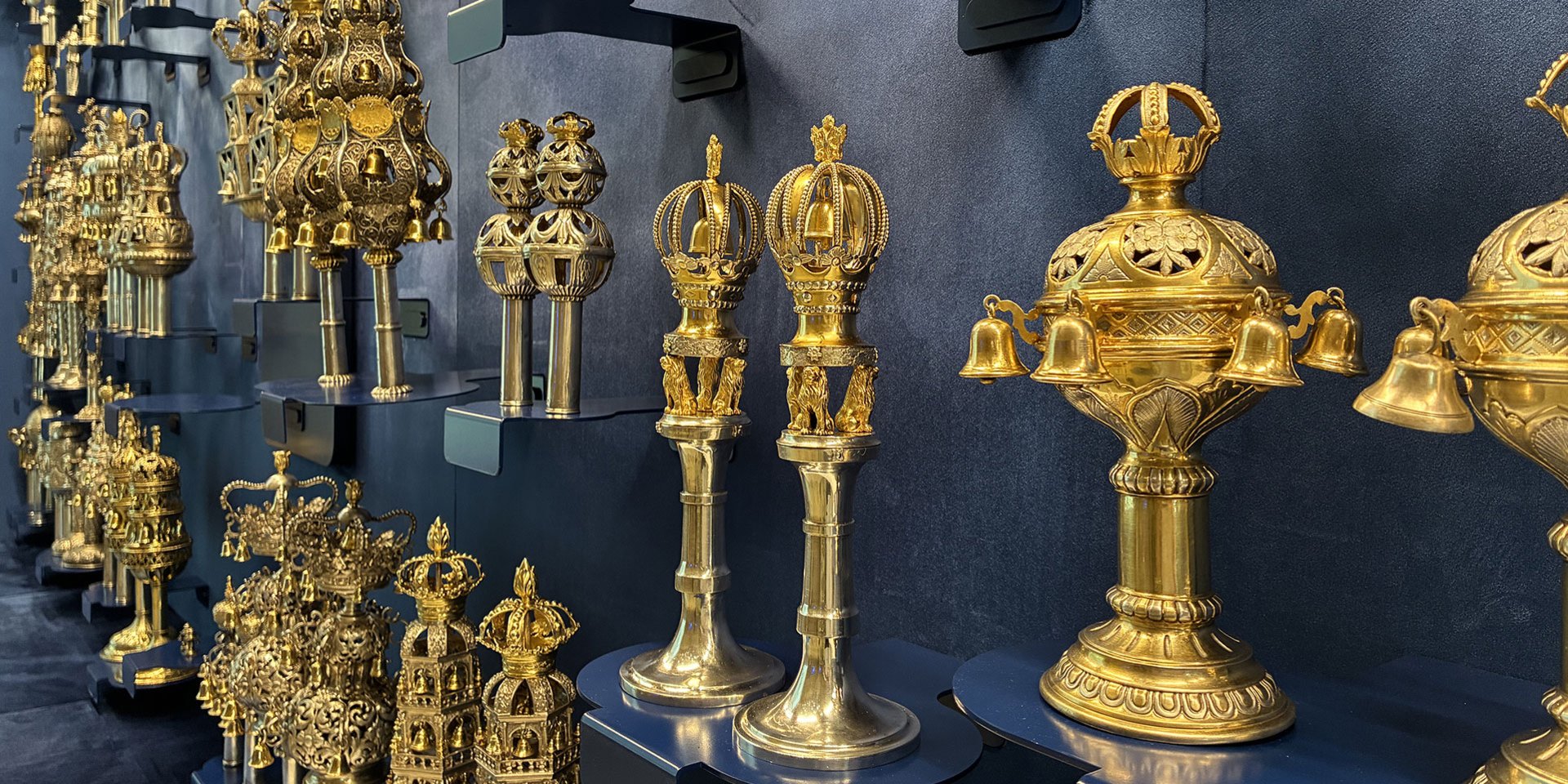

Norbert Cymbalista’s unique collection includes Torah finials from Europe, North Africa, the Arab world, and East Asia. These exquisite pieces display a wide variety of forms and materials and illustrate how migration and cultural exchange have shaped the evolution of Jewish tradition. At the same time, they underscore the cohesion of the Jewish community, which has upheld the same ceremonial rites worldwide for centuries.
With the presentation of 72 rimonim, the Jewish Museum Frankfurt will, starting September 3, display one of the most significant private Judaica collections in its entirety for the first time: in a large display case in the library, which has been specially renovated for this purpose. In addition to information about the objects, tablets on display also feature an interview with Norbert Cymbalista, who was born in Worms 100 years ago.
Rimonim from Iraq, 1890–1910, silver
Rimonim from Yemen (Aden), 1800 / 1938, silver
Rimon, one-of-a-kind piece, Italy (Venice), ca. 1695, silver
“Rimonim from Around the World: The Cymbalista Collection of Torah Ornaments” offers a unique window into the diversity of Jewish ritual art and combines aesthetic fascination with a transnational perspective on Jewish culture.
Norbert Cymbalista – A Turbulent Century
Norbert Cymbalista was born on July 8, 1926, in Worms and, as a child, experienced the systematic discrimination and deprivation of rights faced by Jews in Nazi Germany. He started school on the day the Nazis seized power, but as an eight-year-old, he was forced to leave the public school system in 1935. In October 1938, he was deported along with thousands of Jews from Eastern Europe as part of the so-called “Poland Action” and ended up in no man’s land with his parents. They managed to take a train back to Worms, where they experienced the November pogrom.
On Carnival night in February 1939, the twelve-year-old fled alone on foot to Belgium and arrived at his uncle’s home in France in March 1939. When war broke out, he returned to Worms to persuade his parents to flee as well. They followed their son to Antwerp in October 1939, but were interned for crossing the border illegally and were not released until May 1940. Together, the family fled on foot to Marseille to escape the advancing German Wehrmacht. When the Vichy government began deporting Jews in September 1942, Norbert Cymbalista and his parents decided to attempt to cross the border into Switzerland and forged their identity papers. While still in the border region, they were apprehended by the police and taken to three different internment camps. The parents remained interned until the end of the war; Norbert was released after two years thanks to a priest and witnessed the end of the war on May 8, 1945, in Zurich.
Due to a lack of identification papers, the family was forced to leave Switzerland once again. Norbert Cymbalista walked to Milan. He settled there for 30 years, built a career in real estate and finance—without a formal education or financial support—and met his wife. In the 1970s, the couple moved their primary residence to Switzerland.
Norbert Cymbalista, his parents, and two cousins are the only members of their large, extended family to have survived the Shoah. Against this backdrop, the philanthropist has made it his life’s mission to strengthen Jewish religious culture. He is initiating and building the Cymbalista Synagogue on the campus of Tel Aviv University, designed by Swiss architect Mario Botta, which will provide a space for both secular and Orthodox Jews and will include a center for study and dialogue. The shape of this synagogue is inspired by the Torah scroll, specifically its crown, the rimonim, which is the focus of his passion for collecting.
What are Rimonim (Torah ornaments)?
Rimonim (hebräisch: רִמּוֹנִים, Singular: Rimon (literally, “pomegranates”) are artistically crafted Torah finials that are placed on the two wooden rods (Atzei Chayim, “Trees of Life”) of a Torah scroll. They are among the most important decorative elements of a Torah scroll and are part of Jewish ritual art (Judaica).
They owe their name to their shape, which often resembles that of a pomegranate. In Jewish tradition, the pomegranate is considered a symbol of fertility, abundance, and the commandments of the Torah.
Rimonim express the special reverence accorded to the Torah as a sacred text. According to Jewish religious law, they are classified as Tashmishot Kedushah (“vessels of holiness”), as they serve the Torah scroll directly.
As artifacts of art history, rimonim reflect the diversity of Jewish communities worldwide. Their forms, materials, and ornamentation vary depending on their region of origin and period of creation, and they tell of religious traditions, craft techniques, cultural exchange, and the lived experiences of Jewish communities in Europe, North Africa, the Middle East, and Asia. Therefore, they are not only liturgical objects but also significant sources for the history of Jewish culture and migration.
Curator-Led Tours
On Thursdays, October 15, October 29, and November 5, 2026, Dr. Eva Atlan, the curator responsible for the new exhibition, will offer an introduction to the Cymbalista Collection at 6:00 p.m. each day, followed by a tour of the Judaica objects in the permanent exhibition.
Participation is included with museum admission. Space is limited. To reserve a spot, please contact: juedischesmuseum.de/tickets
Event location:
Library in the Jewish Museum
Opened today: 10:00 – 18:00
The entrance to the library is free.
Bertha-Pappenheim-Platz 1, 60329 Frankfurt am Main